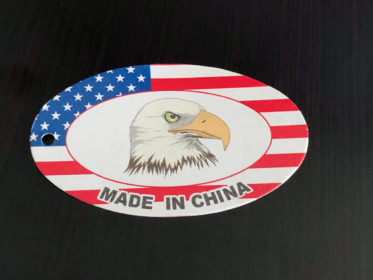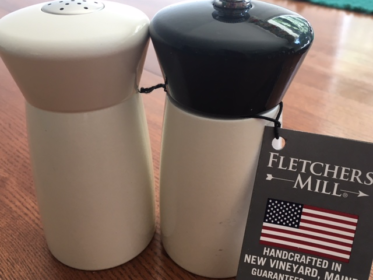

Manufacturing in the United States isn’t easy. Companies large and small deal with onerous federal and state regulations, stiff competition, and finding and keeping skilled workers.
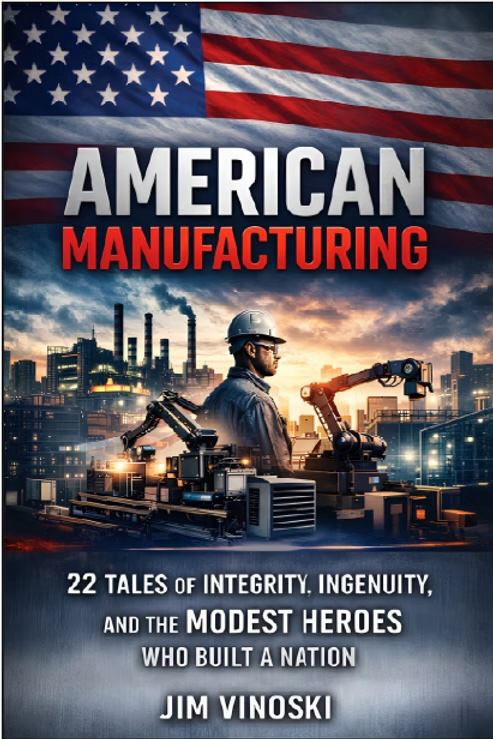
The 22 companies featured in Jim Vinoski’s new book, American Manufacturing: 22 Tales of Integrity, Ingenuity, and the Modest Heroes Who Built a Nation, have been up, down, and sideways, but they’re still going strong. In fact, they’re better for it.
By the second chapter, I found myself underlining whole passages and dog-earing other pages on why these unsung heroes continue to manufacture in the United States — and how and why they prosper.
“Writing this book,” says Vinoski, “reinforced my belief in how critical the people are who do the work – I mean, the skilled technical workers. We as a culture don’t appreciate them or value them as we should.
“Lots of ink has been spilled on this topic, but it’s mostly been fluff versus proposing how we do things differently. Part of the problem is, we’ve spent three decades denigrating manufacturing jobs. Instead, we venerate people with degrees and credentials.”
Yes, exactly. Reading the stories of the companies profiled, you realize just how smart our skilled workforce is – and how much our country depends on them to keep things running. They’re the ones coming up with solutions to challenges or technological innovations – not the machines or the people in academe.
If you live in a working class neighborhood the way I do, you already know this. It’s the trades and those in manufacturing, construction, etc. who are up before dawn and driving to work. Whether they wear hardhats and work boots, protective clean room gear, or simply jeans and t-shirts, the people who comprise our skilled workforce are critical to American manufacturing and our local communities.

“I realized,” Vinoski goes on to add, “that our ‘heroes’ – the ones who get the most attention — are the larger corporations. Yet, most manufacturers are still privately held and they’ve been around for decades.
“The reason is because they can do things public companies can’t do. They have long-term vision. They make take a hit, but they get back up. These are the companies I feature in my book.”
Pick it up – start reading anywhere
When the book arrived, I scanned the Table of Contents; the chapter for Revere Copper immediately caught my attention. The company used to produce the iconic Revere Ware Cookware with the copper bottoms.
Writes Vinoski, “Formerly introduced at the Chicago Housewares show in 1939, the brand fell on hard times in the latter years of the 20th-century, with the brand trading hands several times from the late 1980s on.”
As soon as I read that, I jumped up to check my Revere Ware pots. Mine are stamped, “1801 – Revere Ware – Clinton, ILL. U.S.A.” I’ve had them for over 45 years. They were a Christmas gift, ca. 1981, from the woman whose house I cleaned weekly.
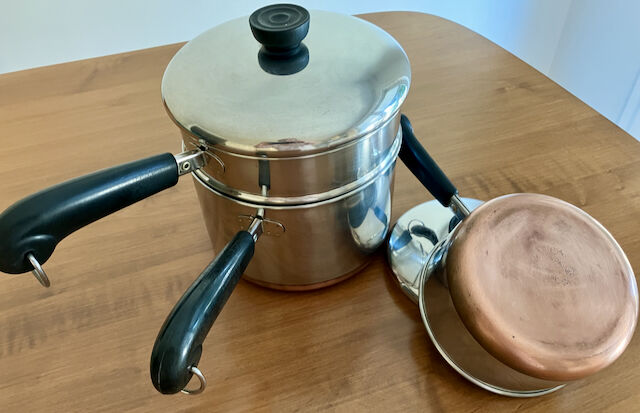
Flipping back to the ToC, I found a few other familiar friends including Cutco Cutlery, Regal Cookware, and Fiesta Tableware — and kept reading. I resurfaced an hour later. (It’s a really good book!)
“Did you run into any surprises?”
Vinoski says he had a lot of fun visiting some of the manufacturers he profiled, but when I asked if he had any surprises, he immediately mentioned the Manthei Group in Petoskey, Michigan.
As he writes in the book, he came across a LinkedIn post about Redi-Rock, “which makes these huge retaining wall stones you see in highway projects and other large construction applications.”
He contacted the guy who posted it, who told him the company who made them was located in Petoskey.

“I found that curious,” he wrote in the book, “because Petoskey is a on a gorgeous stretch of the Lake Michigan shoreline in Lower Michigan, and it has long since become resort central.
I found it odd that a big manufacturer would be located there.”
So he made the drive and discovered the Manthei location is full of sand and gravel pits and concrete plants.
“It was business after business under one family name – and you’d never know they were there! In a resort town!” he said to me.
“The company is a pillar of the community – the very best people in business. In the book, I cover how they take really good of their people and their community. It’s a very cool story.”
The U.S. is the world’s second largest manufacturer
Like Vinoski, I interview manufacturers regularly – but even I learned a lot reading his book.
I did not know, for example, that the number one snow making machine is made by SMI Snowmakers in Midland, Michigan. The company’s machines made the snow for the 2018 Winter Olympics in South Korea.
I found myself smiling at the image of Lockheed engineers riding their Worksman Mover Industrial Tricycles around their facility — Worksman Cycles being the oldest bike company in America.
I’m now on the lookout for Victaulic industrial pipe couplings, and in the chapter about bike parts maker SRAM, LLC, I wrote: “Buy a new bike, please.”
I also learned – or maybe I already knew but hadn’t considered it – we’re the world’s next-to-largest manufacturer, second only to China.
As I said to Vinoski during our call, we should be proud of our manufacturing prowess, innovation, and staying power, considering what’s transpired in the last few decades, from off-shoring and whole industries being decimated to the demise of vocational training in high school – plus the challenges manufacturers face every day.
Vinoski agreed. “While manufacturing took a nose-dive in the late 1980s, it began growing again in 2010, then took another nose-dive during COVID. But it has since recovered and is now 11 percent higher than it was 15 years ago.
“What I learned from writing my book is that there remains a core of proud and efficient U.S. producers who have kept fighting the good fight. They deserve real praise.”
Recommendation: Buy this book and read it!

You can find American Manufacturing at Barnes & Noble and Amazon or purchase a signed copy directly from Vinoski. (All links below.)
You can find Jim Vinoski on various platforms. His Manufacturing Talks podcast is available on YouTube, iTunes, etc. and he publishes a Substack newsletter.
You can follow him on LinkedIn – which is how I discovered him several years ago after he posted his Forbes article about the Zamboni company (also in the book; fantastic story!).
In addition to being a podcaster and author, Vinoski is a Visiting Fellow at the National Center for Energy Analytics, a non-profit organization with a focus of using facts to identify sensible public policies for affordable, reliable energy for America.
Thank you again, Jim! I love your book; congratulations on your success.
Links
Manufacturing Talks: www.manufacturingtalks.com
American Manufacturing (the book): www.manufacturingtalks.com/american-manufacturing-book
Substack: substack.com/@jimvino
LinkedIn: www.linkedin.com/in/jimvinoski
National Center for Energy Analytics: energyanalytics.org
Jim’s interview of me for the Manufacturing Talks podcast – one of his early episodes. I still love this interview. Very fun!
Full Disclosure
I’m not paid nor asked to write about products or the companies that make them. All links in this piece are FREE — meaning, they’re not sponsored or paid for.
My mission is to keep manufacturing jobs stateside and this blog is my way of giving back. We like to think a “small” choice, such as purchasing something made in the US by American workers, won’t make a difference. It does.