

New England’s distinctive red brick mill buildings are a tangible reminder of the region’s role in America’s manufacturing history.
Boott Mills in Lowell, MA, for example, was founded in 1821 for the purpose of manufacturing cotton textiles and woolen goods. The mills were situated near the 110-mile mighty Merrimack River; canals were built to take advantage of hydropower. To the north, the New Hampshire Manufacturing Corp, located on the Nashua River, also manufactured cotton textiles and woolen goods.
The textile mills marked the start of the Industrial Revolution, and towns across New England began to grow as industrialists and inventors founded machine shops, iron foundries, railroad shops, and sundry other businesses.
Today, these iconic red brick mill buildings are relics. Some stand empty, waiting for someone with vision to bring them back to life. Others have been repurposed into condos or mixed-use residential / commercial concerns. And still others have been demolished.
Greenerd Press & Machine Company of Nashua, NH, has also played a key role in New England’s industrial story.
First a manufacturer of Arbor Presses in the early 1880s, and today state-of-the-art hydraulic presses, Greenerd’s story is unique because it’s also intertwined with its vibrant and historic mill building.
Greenerd’s manufacturing history
Founded in 1883 in Boston, MA, the company began doing business as Greenerd Arbor Press Company when Edwin E. Bartlett purchased patents for the machine.
It was Robert Greenerd who developed and patented the Arbor Press. A manually operated machine, the Arbor Press incorporated “a rack and pinion mechanism to generate large pressing forces with precise control.” It also eliminated a primitive sledgehammer method of pressing an arbor into a lathe.
After purchasing the patents, Bartlett worked with the Massachusetts Institute of Technology to develop the Arbor Press from a simple small machine into a complex of special machine types “designed to press up to 30 tons utilizing compound gears and leverages. With these and other improvements, Greenerd Arbor Press developed a reputation for quality and craftsmanship.” (Source: Vintage Machine — all links below.)

With business booming, Bartlett needed more space. He first relocated to South Boston, and then in 1903, he moved the company to 41 Crown Street in Nashua, NH – where the company has been located ever since.
Wonderfully preserved, the Greenerd mill building is nestled into a mixed use residential neighborhood. Directly next door is a double-decker two family residence; down the street are several other mill buildings mixed in with other residences plus smaller businesses.
It looks like a quiet working class neighborhood indistinguishable from the next, except it’s not – and that’s because of its history.
“The mill buildings were owned by the William Bartlett Co.,” says Tom M. Lavoie, Applications Engineering Manager for Greenerd Press & Machine Company. “We believe our building was used for pattern making. The building behind us was the foundry; the others were focused on machining and assembly.”
I spent several hours researching Nasha’s history, but had a hard time confirming the early history of the Wm. Bartlett Co. I’m surmising it’s because the company, and Crown Street itself, played a smaller role to their much larger textile mill cousin, the Nashua Manufacturing Corp. located on the Nashua River; hence, it didn’t get as much attention.
However, evidence does suggest Lavoie is correct. By 1878, Nashua was the second largest city in NH, with six major interconnected railroad lines. The rail lines actually run behind the Crown Street buildings – which would have made it easy for Bartlett and other manufacturers to “ship freight and product anywhere in the world affordably and easily,” according to the City of Nashua website.

According to Lavoie, the military purchased thousands of Arbor Presses for munitions assembly and manufacture for both World Wars. Don Moodie, son of the second company owner, William Moodie, told Lavoie that he had heard from the Bartlett family that train cars used to pull up outside of Greenerd where they would load hundreds of Arbor Presses on them for shipment to the munitions factories.
In the photo below, of the shop floor taken in the 1960s, you can see the leather belts coming from the ceiling to the machines to power them. Lavoie confirmed that the Merrimack River (a very short walk from the factory) did, at one time, play a role in the running of the machines at Greenerd – although by 1960, the factory would have been fully electrified.

Greenerd Press & Machine today
The company built its first hydraulic press in 1934; three years later, the company name was changed to Greenerd Press & Machine.
While the company still sells some Arbor Presses, its main concern is developing custom hydraulic presses to meet specific application challenges – from artificial skin to straightening 40-foot long Cannon tubes to all things in-between.
The company was the first hydraulic press manufacturer to add an HMI – or visual interface – for digital control of press functions, among other innovations.
Currently, the Greenerd team consists of 25 people who build between 20 and 70 machines a year, depending on type and product mix. All Greenerd hydraulic presses are designed, engineered, and built to customer requirements.

“We design, spec, and domestically source all components,” says Lavoie. “We build all our own power units and spec every component in them, including the valves, coils, etc. The electronics in our PLC units – we source those domestically as well. We design, engineer, and install any component add-ons, such as Fanuc robotic arms.
“Every press is built right here in Nashua and is backed by the New England pride and quality that made Greenerd a name people could trust over 100 years ago.”
The company was owned by the Bartlett family until 1962, when it was sold to William Moodi; his son Donald Moodie ran it until 2012, when he sold it to Jerry Letendre and his wife Dafney Phua, who is the CEO.
The fact they’re only the third owners in the company’s 143 year history is a testament to the company’s strength and longevity.
Since taking over, Jerry and Dafney have been making improvements, such as replacing the windows and restoring the wide pine floors – which are gorgeous! It’s the first thing I noticed when I came into the building.
Lavoie took me upstairs so that I could see the old belt pully mechanisms attached to the ceiling that Letendre has restored. The upstairs space, with the sun streaming through the big windows, took my breath away.
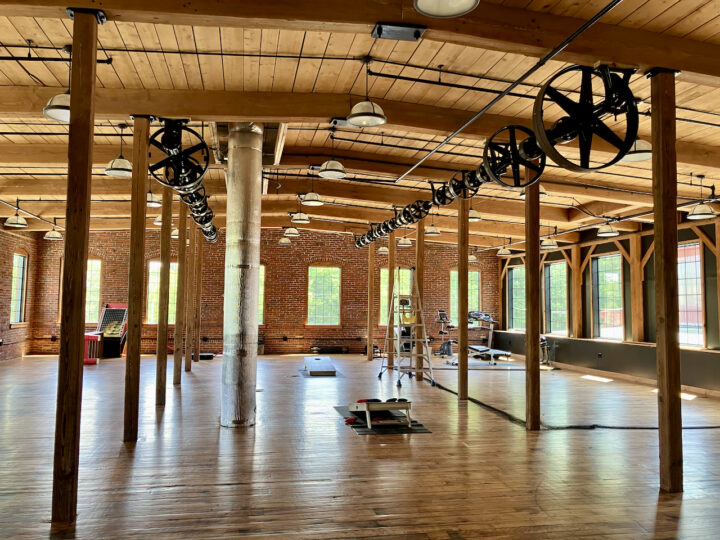
Says Lavoie, “Letendre’s intent is to also restore the machines. But for now, the shop guys use this space to work out or take a break.”
An amazing story of a company . . . and a building
“Longevity is part of our history,” sums up Lavoie. “I’ve been here 30 years. The guy I replaced had been here 50 years. Our service manager – he has 46 years. But we’re also cognizant of change. We have a new crew of engineers and assembly people coming in and that’s good.”
When we finished our tour, I found myself sitting in my vehicle, gazing at the beautiful brick building with its windows glinting in the sun and neatly trimmed grass. It felt alive, prosperous, and ready for another 100 years.

“What an amazing story,” I kept thinking, and then my thoughts turned fanciful.
If buildings have souls, which I believe they do, then the Greenerd mill is a wonderful example of how a well-cared for building, and the people who work in it, nurture and sustain one another.
As with people, buildings need a purpose. Kudos to Greenerd for continuing to build machines in its historic mill – and for keeping manufacturing right here in the United States.
Thank you, Tom Lavoie, for your time and perspective on a late Friday morning. I very much enjoyed it!
To learn more about Greenerd Press & Machine, visit their website: www.Greenerd.com.
Links
“Edwin E. Barlett and the Arbor Press,” VintageMachinery.org
“History of Nashua,” Nashua.gov
Arial view of Crown Street, Nashua, Seth J. Dewey Photography
Video of Greenerd #3 Arbor Press, 3 Ton Type, YouTube
“Stamping 101: How does a hydraulic press work?” The Fabricator, October 2021
Full Disclosure
I’m not paid nor asked to write about products or the companies that make them. All links in this piece are FREE — meaning, they’re not sponsored or paid for.
My mission is to keep manufacturing jobs stateside and this blog is my way of giving back. We like to think a “small” choice, such as purchasing something made in the US by American workers, won’t make a difference. It does.