
When I founded Huff Industrial Marketing in 2014, I did so with one objective in mind: I wanted to create a business based on my own ideas and tested practices.
For years, I had read research and listened to industry gurus talk about how companies didn’t know if their marketing was working. This was mostly due to department silos, lack of agreement on what to measure, etc.
So in 2014 I said, “I want to change this. When manufacturers work with me, I want to prove the marketing my team and I provide actually works.”
School of trial and error
Early on, I made some mistakes because I was still operating under what other people said worked. I also didn’t have my own internal measurement systems in place.
I actually lost one client because when we sent out the first issue of the newsletter, the client was concerned he didn’t get any leads. That set me back a bit. Today I’d say, “A newsletter is great for brand awareness, building trust, and keeping your company name in front of people. We have far better methods for delivering website conversions.”
After that incident, I began looking for ways to show conversions — aka inquiries or leads. I learned Google Analytics inside and out. By 2018, I was providing clients with simple conversion reports.
The wonderful benefit of doing these reports is that the more I analyzed data and applied it, the better my team and I became at creating websites for manufacturers that delivered real leads.
2023: Introduced my new Conversion Report
My son James, a software coder, was laid off, which freed him up to work for me. I asked him if he could automate my reports, which I had been compiling manually each week and month.
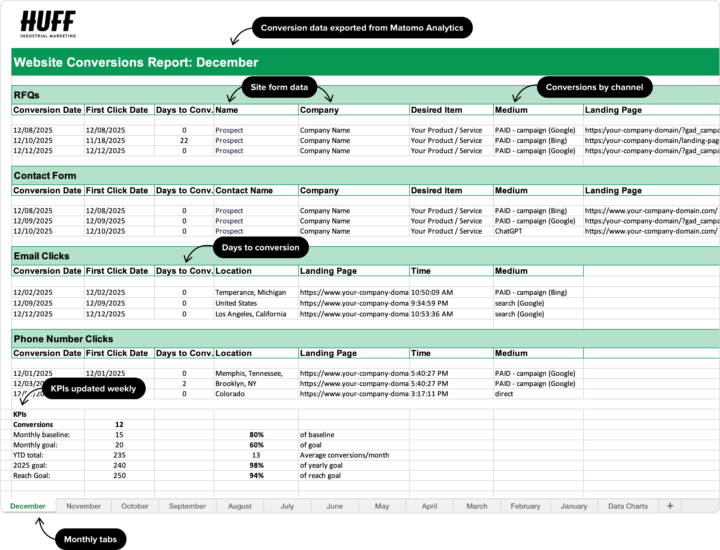
He went to work. Using the Matomo Analytics API, James created a function where data is exported directly into the new spreadsheet you see in the image above. (My designer, Rachel Cunliffe, designed it.)
What a huge difference this report has made! Clients love it.
Since its introduction, I’ve made continual tweaks to the report — many of which you can see in the image above:
- Each report includes monthly tabs, so that clients can see conversion data by month and year-to-date.
- KPIs are listed on each current month and are updated weekly. If the goal is 30 lead conversions per month, the client can see immediately where we stand.
- WordPress RFQ form data is matched to Matomo data; I manually add the name and company of the inquiry; clients also have other data they want to track, so that gets added as well.
- The report shows conversions by channel, which means we track where the lead came from: Ads, non-paid search, AI agents, LinkedIn (or other social), etc.
Clients and I now easily track won proposals back to these reports. I do a little dance each time this happens. Woohoo!
The metric of which I’m most proud: Days to Conversion
Huff Industrial Marketing clients see an amazing 70% or higher Zero Days to Conversion metric.
What this means is, a prospect comes to the website and converts on the same visit. By “conversion,” I mean completes the RFQ or other form, emails, or calls. (I manually review all form submissions and remove any spam ones. Ditto for obvious email spam.)
What the Days to Conversion metric tells me:
- The websites my team and I create are huge trust signals because they’re professionally designed and built based on client goals and objectives.
- The content — from copy to images — demonstrates the client’s expertise and quickly establishes trust. Content is always written for the client’s audience versus Google.
We don’t do “cool” or trendy. Instead of asking AI agents for ideas or strategy, I continually work with clients to refine, refine, refine based on what sales hears from customers and prospects.
And so, people reach out — whether they come to the website from “free” search, paid search, word of mouth, or wherever.
Most importantly for me, however, is that the Days to Conversion metric proves my holistic approach to marketing works. I have the results to prove it.
Conversion Tracking is part of my new Lead Generation Marketing Program for manufacturers. This program includes Content Marketing and Pay-Per-Click advertising. It’s an integrated approach that works.