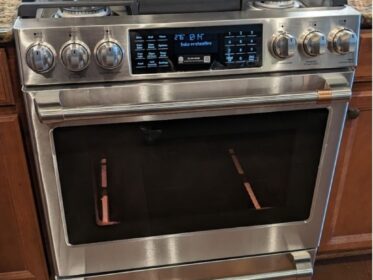


One of the burners on my ca. 2001 GE electric stove stopped working. Since I was now hooked up to natural gas, I began researching gas stoves . . . until my HVAC guy said my cabinets weren’t up to code. The bottom height was too close to the stove; I’d need to replace them first.
Finding someone to repair the stove took some creative online searching. Many of the appliance repair businesses look sketchy, or they’re owned by private equity.
I wanted local and independent. It took me several searches to figure out I had to add these phrases to my search query, but once I did, up popped George, the appliance repair guy, located a few towns over.
He came to the house at the appointed time and after a few minutes with my stove said, “This burner is fine.” Of course it was, haha! We ended up chatting about appliances and Made in USA.
He said, “I have to charge you the service call fee; while I’m here, do you have anything else that needs attention?”
“Yes,” I said, “I have this really old dryer that no longer works.”
My son’s father (of blessed memory) and I had purchased the matching Sears Kenmore washer and dryer before our son was born. They served us well for many years. The washer died first; I replaced it with an LG high-efficiency top loader.
The dryer kept working, and working, and working, until one day, it stopped. I pressed the button to dry a load . . . and silence. By this time, I was into my “buy Made in USA” commitment but put off buying a new one due to indecision and other factors.
The dryer sat down cellar gathering dust. I knew I needed to have it removed, but doing so involved a lot of effort. It was easier to ignore it. (During this time, I used a wooden clothes drying rack made by Pennsylvania Woodworkers. I loved it.)
George and I went down cellar. Instead of being appalled at my dusty, rusty dryer, he was excited. “Oh, this is a great model,” he said. “It has a majority of U.S. parts. It’s simple and basic.”
He pulled the dryer out from the wall, took off the back, ran a quick test, and said, “Ah, it’s the fuse.” Ten minutes and a new part later, my dryer was working again. He also installed a new flexible air vent hose thingie. Hurrah!
Once he was done, he said, “This dryer has years of life left. Don’t get rid of it.”
Trades people are a font of knowledge
I always make a point to talk to the trades people who come to my house. How did they get started? How long have they been in business? When the chimney guy was here several years ago, I learned my gym trainer was his trainer, too. Small world!
In business since 1980, George knew everything about appliances: the makes and models, which brands to buy and which to stay away from.
When I told him I had been thinking of replacing my dryer with a Made in USA Speed Queen, he said, “Yes, Speed Queen is good, but the problem is our government. They’ve single-handedly destroyed the appliance industry due to over-regulation.”
According to George, appliances no longer perform or last they way they used to and often break down shortly after the warranty expires. The reason: Manufacturers have to cut costs to meet stringent efficiency and environmental regulations.
While a company like Whirlpool will claim “Made in USA,” this claim is only for certain models or lines. Part manufacturing is often outsourced.
When I took delivery of my Whirlpool refrigerator, for example, I learned with dismay that it had been made in Mexico. It took me forever to find the tiny label hidden inside the unit. (I even called the company before buying to confirm Made in USA and was told, “Yes, the majority of our lines are made in the United States.” I will never forgive them for this.)
Another problem: appliances now incorporate electronics, touch screens, etc. — all of which add complexity. George pointed to my LG washer, “This is a good model because it’s older, even with the electronic panel.”
According to George, replacement electronic panels are often backordered — three, four, or even five months.
“By the time a replacement panel comes in,” he said, “the homeowner has bought a new appliance.”
Connection doesn’t replace conversation

In his book, Digital Minimalism: Choosing a Focused Life in a Noisy World, Cal Newport discusses how we need face-to-face conversation in order to thrive as humans.
“It’s what we crave as humans and provides us with the sense of community and belonging necessary to thrive,” he writes. In other words, conversation is vital to our emotional and mental well-being.
Connection on social media, he says, doesn’t replace real-life conversation.
I think the same can be said of appliances. These days, you can connect just about anything in your home to the Internet. These connections can be controlled by apps on your mobile device.
But as Basecamp co-founder Jason Fried learned, all this technology adds unnecessary complexity, especially for simple tasks. In a post on LinkedIn, he talked about renting a “smart home” for his parents. The touchscreens, interfaces and apps were difficult to use and understand. Turning off the lights, he wrote, required a demo!
I like to joke that the only smart thing in my house is my dog Rocky. All my appliances are either analog or not connected. Based on what I learned talking to George, I won’t be making any changes.
Buying Made in USA tip: Find independent trades people you can trust
While writing this post, I had a conversation with my neighbor, who is considering replacing his burner. After several issues with the big repair company, he had finally found an independent furnace guy who discovered the big company had installed the incorrect nozzle. It was squirting heating oil all over the heating box — and thus burning it up.
Experienced independents know their industry, the key players, which products to buy — and can provide straight-forward advice. Plus, they’re often pro-Made in USA. My HVAC guy, for example, makes a point to use U.S.-made products as much as possible. My sump pump guy does so as well.
As he was packing up to go, George said, “Call me before you buy your gas stove. I’ll recommend a few models for you. And that dog of yours — he’s a German Shepherd who thinks he’s a Golden Retriever. All he wants to do is play.”
Haha — yes. He loves trades guys because they’ll often throw sticks for him.
I thanked George for his time and said I’d call him once I was ready for the stove. Having his help will save considerable time.
What’s your experience with appliances? Do you still have older Made in USA appliances, such as a 40-year old water heater, still going strong? Leave your story in the comments.
Links
Considerations for Buying a Major Appliance — Made in USA — A Keep It Made USA write up. My colleague, Allison Giddens, shares her experience buying a GE Cafe Oven Range made at the Roper Corporation assembly plant in Lafayette, GA. The plant is one of the largest employers in the state with more than 2,000 employees. GE is now owned by Haier, a Chinese company.
Made in USA: Pennsylvania Woodworks Clothes Drying Racks — A Keep It Made USA write up. Note: I did confirm this company is still in business. I’ve had several people tell me they’ve purchased one of these racks and love it.
The Big Regression — An interesting post on LinkedIn, by Basecamp co-founder Jason Fried, on his experience of renting a “smart home” for his parents — and how much complexity all this technology added.
“Sears had 3,500 stores in the US. Now they just have 8. Here’s how to visit the one in MA” — by Rin Velasco, Patriot Ledger, June 26, 2025
Full Disclosure
I’m not paid nor asked to write about products or the companies that make them. All links in this piece are FREE — meaning, they’re not sponsored or paid for.
My mission is to keep manufacturing jobs stateside and this blog is my way of giving back. We like to think a “small” choice, such as purchasing something made in the US by American workers, won’t make a difference. It does.